menu Home About Me My Donations
Showing posts with label Classroom Management. Show all posts

Back to School Basics - Teaching Good Classroom Behavior

School has started for me! I teach for a modified year round school district. My six week Summer has come to a close. The night before school started I posted this picture to my Facebook much to the amusement of my fellow teachers on there. I'm sure they felt the same way.

Janine Campos' blog
Back to School Napping Thoughts

When my kinders came to me this Monday, July 28, I was excited because last year I taught a kinder first grade split class which meant I had to go fast sooner. I missed the full "kindie" experience a lot. This week, I started establishing routines and procedures as well as practicing those preschool academics like tracing, circling, coloring, Xing out the wrong answer and circling the correct answer.  Most importantly, I am working on teaching good classroom behavior... starting with walking in line.

student behavior for kindergarten
Walking In Line for Kindergarten

Here is my wall of rules. It is right by the entrance and we go over the class rules every morning. 

Kindergarten classroom behavior
Classroom Behavior Posters

Beginning of the School Year Kindergarten
Classroom Management for Back to School Season

I have each poster in a PDF file so I can add it into a flip chart and display on my class' Promethean board for the kids each morning until they master them. To download a FREE SAMPLE POSTER for walking in line (shown in above picture on the right) click here. 

At the end of the day today, I tried giving them this handout. It utilizes the same adorable clip art from the posters. ( made by Educasong on TPT ) they did very well with it since they had to color to mark their answer and it's a skill we've been covering all week long. 

first 6 weeks of school for Kindergarten
Kindergarten Behavior Printables for Back to School Routines and Procedures


As I was waiting for the clock to strike in my classroom so I can head home,  I managed to get all these beauties copied, cut, collated, and stapled for the second week of Kindergarten.

Teaching good behavior in kindergarten, RTI
Class Behavior No No's

The above booklet helps to give examples of what NOT TO DO. Kids echo repeat the pattern sentences and trace the NO on each page. We will have a class discussion on each behavior and color the cute images.  It's been five days of kinder and I've already had someone throw a tantrum so this will come in handy next week.  

kindergarten RTI behavior strategies
Reminds me of the Marine Corps chants they sing as they run miles

The above booklet covers our walking in line chant. We recite it every time we need to walk as a class anywhere on campus. "I don't know but I've been told, Kindergartners are made of gold!" Just kidding. Our chant is soo much cuter. There are more pages in the booklet but they're not featured in the image above.  


teaching good behavior in Kindergarten
Being a good friend in Kindergarten

The above booklet is the opposite of the No-No's book. It gives all the great examples of kind and responsible behavior.

classroom management kindergarten
Teaching Good Behavior in Kindergarten

To have copies of all of the above handy, dandy PRINTABLES click this title: "Teaching Good Behavior in Kindergarten"

Posting a Class Schedule

I always post my class schedule front and center for my students. The first three months of school I refer to it constantly. During transitions, I turn each card we've completed over so students can see a visual I how many more subjects are on our to-do list before it's time to go home.

Kindergarten Schedule
I use two small pocket charts I bought from the dollar bin at Target. As you can see above each subject has a visual aid to help kids understand better. If you'd like to download the schedule cards I use above, here is the link.

Kindergarten Schedule Cards for Back to School

Kindergarten Schedule Cards - Page 2

Kindergarten Schedule Cards - Page 3 of 6

Back to School Basics: Classroom Zones

Guided Reading is one of the most important parts of the day. Students learn so much and there is no time to waste. Having excellent classroom management during this time is key. One of the best strategies to accomplish this goal to think of classroom zones for each of your student groups to physically encompass, think of what the theme of each center is going to be ( what skills each center will focus on consistently), think of what each group is allowed to do when they're done with their assignment.

Here are my four centers, their themes:

Guided Reading in Kindergarten
At the teacher's Table, I am there to guide the children through the rigorous activities. At the Listening Center the children listen to a story for 10-15 minutes before they complete their assignment at their seat or use a Literacy Puzzle. At the computer station, each of the six children has a computer game to do. 10 minutes of Reading Readiness game and 10 minutes of a Math game. However, one center is completely independent for the full 25 minute rotation.  The independent table is by far the neediest table for teacher-organization!

Here is my layout.
Kindergarten Guided Reading - Independent Seat Work

Kindergarten Seat Work: Phonics Sound Sorts
At this table I usually have cut and paste phonics activities for the kids to do because I like how it slooows them down and makes them think before they commit to gluing down a picture. Also, it is great fine motor practice. I only place four trash bins on each table because the children are expected to share with their neighbor. Each child has their own pencil box with supplies ( the boxes stay at the Independent Table). I like placing trash bins at the table because this keeps the kids from standing up and chatting with other kids. They have to stay in their zone. To keep them in their zone ... and keep them from getting up and distracting other kids I have an activity prepared for them to do when they are done with their phonics sort page. 

The table is right against the word wall so they are to write sentences on lined white boards. They love to choose different colored markers. 

Early Finishers Activities - White Board Sentences


Another option is magna doodles. They love those too. Both options are kept close by the table for kids to access with leaving their zone. 


Early Finishers Activity - Magna Doodles

Here are some typical phonics activities I have for the children at the independent table on a daily basis.    Letter of the Week, Vowel Review, Sight Word Work, Phonics Cut and Paste, and Word Families.

Vowel Letter Review - Cut and Paste

Short Vowels Worksheets 
Digraphs Worksheets for Kindergarten -
Picture Sorts

Sight Word Worksheets for Kindergarten

Sight Word Worksheets for Kindergarten
Sight Word : THE

Word Families Review for Kindergarten
CVC Words Literacy Center

Short E - Word Family Worksheet
Word Work for Kindergarten

Back to School Basics : Classroom Behavior System for Kindergarten

Daily Accountability is key for Kindergarten and First Grade Students. A weekly behavior system will not be as effective. My students go home from school EVERY DAY with a colored behavior card that communicates to parents what their child's behavior was like that day.

I organize my notes like this:


Blue Card - Daily Classroom Behavior

Green Card - Daily Classroom Behavior Note

Yellow and Red Card - Daily Behavior Card


Blue Cards Top Drawer
Green Cards Middle Drawer
Yellow and Red Cards on the Bottom Drawer

I run them off on colored paper to match the card color.

Back to School Basics: Classroom Behavior System

Before the kids ever come through the door I already have my behavior system thought through. Here is the form I give to parents explaining my system. Without good classroom management no one is going to learn no matter how creative and rigorous a lesson may be. In my class, I choose a color bases system. I find the colors are easy for the kids to remember. It's easy to see the difference in color between, say, red and yellow. It's not so easy to see the difference between a clip being raised an inch to another word or to see that a card has been flipped over. Those kinds of systems are not visual enough for a small child. Kindergarteners can barely tell the difference between a b, p, or d!
Kindergarten Behavior Chart
Download my Parent Handout for this Behavior System
 for Free. Great for Back to School Night. 

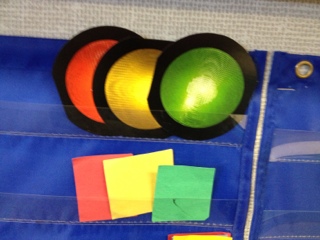
I make sure to provide a legend that explains what each color means in the simplest terms possible. 

Before the kids arrive on the first day I pre-write all of their names and place them in a slot. 


Above is last years behavior chart. For this coming year I have purchased traffic light borders and will use them to replace the wrinkled construction paper squares. 


Parent Support Form


Pretty cool! I like it so far. 

By the way, the blue cards are the best! I give those out when a child shows exemplary behavior, is a role model, helps another child, or just as a surprise for following directions the first time. 

I give parents THIS handout on Back to School Night and explain to them how they can help to reinforce this behavior system with their kids for maximum efficacy. Parent Support is key with children this young.

Back to School Basics: Organizing the Classroom Environment

To help with classroom organization I label students' guided reading book bags according to their shape groups (remember these groups are homogeneous). I use large ziploc bags to house their leveled readers. During writing time, I pull student groups to the teacher's table by their color groups (remember these are heterogeneous). I use color team labels to house their writing journals. Once students memorize their shape groups and color groups they can put away their journals or book bags independently.

Classroom Organization - Labeled Baskets

I choose to pull mixed ability groups as opposed to leveled groups during writing because of time management. I pull the lowest writing group to my table they will take twice as long as the highest or middle groups. If the group is mixed, however, I can help all students equally and as they finish their journal entry and head off to their writing center, I can keep the neediest students at my table and help them finish their work.

Back to School Basics: Partner Talk for Kindergarten

The classroom rug is a learning environment within a learning environment. It is the best place for strategic partner talk in Kindergarten, First Grade, and Second Grade. The importance of the seating chart on the classroom rug plays a big role in classroom management here. Once I have students in the second and fourth row facing their partner, I pass out "Talking Sticks." They are pictured below. The idea came from a book called, "Structured Language Practice." In our district, we nicknamed all the wonderful strategies in the book as "slips." (More on that later)
Talking Sticks - Kindergarten Partner Talk
Talking Stick - Structured Language Practice
I chose to add a parrot sticker on purpose because parrots talk a lot!  A monkey stick will do the trick too! These popsicle sticks have stickers on the end and they are all the same.  The cup contains 12 sticks; one for each pair of kids. The rule is that only the child holding the talking stick may speak. The other partners must quietly listen. This ensures that children are also listening to their classmate. After a few seconds I ring the bell and that is their cue to pass the talking stick.

Yet another version of talking stick is plastic microphones from a local dollar store or the dollar bins at Target. Same rules, different realia. I like to keep things different for my kinders. To them the slightest change is like a whole new ballgame.
Talking Stick with plastic microphones
Kindergarten Partner Talk -
Plastic Microphones
Besides the trusty, "Turn to face your partner" trick, there are other ways to group children for partner talk that don't involve the carpet seating chart. Here are the contents of the other cup, my Chargers cup. (Can you tell I'm from San Diego?)
Partner Talk - Match the sticker to find your partner
Partner Talk - Select a partner by matching the sticker
It contains 24 foam popsicle sticks. Each foam popsicle stick has a sticker on the end. The matching stick is the same color and has the same sticker as well. To assign RANDOM partners, I hold the cup up above the head of each child so they can't see inside the cup and have them select a stick. After each child has pulled a stick I give the class 1 minute to find their partner and sit together. If you can get all three of the above you'll be good to go when it comes to partner talk.

Covers! Yet another way to sort Kindergarten students into pairs is with thematic hats!

Partner Talk adjustable hats for Kindergarten
Partner Talk in Kindergarten -
Thematic Hats with adjustable
elastic band and brads
Like the foam partner sticks, students get one minute to find a partner and sit down together. You guessed it the flowers must pair up with the bees. No two bees may end up together nor two flowers. These adorable adjustable hats can be made out of any theme : frog and lilly pad, owl and tree, frog and insect, baby animal to adult animal, etc. I selectively choose who is allowed to be a bee and who is allowed to be a flower based on the homogenous ability (shape) groups shown in the prior post found here. For example, Triangles (low) and Circles (focus) will be bees and Rectangles (high) and Squares (medium) will be flowers. This way, there is always a structure to the pairings. This avoids the ol' Blind Leading the Blind scenario.

partner talk in kindergarten
Partner Talk Hats -
Match Snails to the
Leaves
Here is an alternate to the hats I pictured above with flowers and bees. Match snails to leaves. Print out and glue to strips for a quick, easy alternative.

Update July 9th : I just returned from my local Dollar Tree store and found these 3 gems. 
structured language practice - partner talk
Partner  Talk Cards (and Hats)

Milk and cookies ! Ketchup and mustard! Cheese and Mice! So cute. I'm definitely going to make a new set of covers out of the mice and cheese. However, I'm going to laminate and save the other two sets in their card format and pass them out by hand when I want to do partner talk activities. Hope you can make it out to Dollar Tree and snag these up too! 

Back to School Basics: Guided Reading Groups and The Classroom Rug Seating Chart

For the first month or two of Kindergarten I carry on and keep children in "color groups" which are heterogenous ability groups. After I have assessed students and given them time to become familiar with class routines and teacher expectations, I sort them into "shape groups." These groups are homogenous ability groups (phonics and phonemic awareness). I make a hooplah out of it and get the kids excited. It motivates them to learn their new shape groups. I also change the classroom rug seating chart to structure what level student is near what level student.
Partner Talk
Classroom Rug Seating Chart - Ideal for Partner Talk
Rectangle Team is the High Group
Square Team is the Middle Group
Triangles are the Low Group
Circles are the Focus Group

This seating arrangement is ideal for Partner Talk during shared reading or writing! I have students in Row 2 and Row 4 turn to the person directly behind them to answer the questions I present to the group. This works well because it has students chatting with a partner who is not too far away from their literacy ability level. I still continue to use color groups simultaneously so that arrangement looks like this:
Classroom Rug Seating Chart
Homogenous and Heterogeneous Groups
Throughout the school year I change the Classroom rug seating chart various times throughout the school year. For certain, over each of the 4 Quarter breaks my district calendar has scheduled. This ensures that students don't get stuck in their shape groups and are allowed to move up or down to receive explicit instruction at their level. Here is my student list I keep in my Teacher Binder.
Kindergarten Teacher Binder
Guided Reading List
In addition to having my master list in my teacher binder, I post CHARTS of who is in which shape group so that children can learn their shape groups easier. But, most importantly, so that a substitute teacher or student teacher can easily see who is in which group. Yut!
Shape Groups
Guided Reading Groups
Shape Groups
Heterogeneous Grouping
Shape clipart from here. Border clipart from here.

Back to School Basics : Creating Heterogenous Groups with a Classroom Rug Seating Chart

Map of my Classroom's actual carpet

Once school gets rolling, I group my students in color groups. Before my district purchased this carpet for my classroom, I had 6 children in 4 color groups (red, orange, yellow, green) and the carpet had more than enough of each colored square for each child. However, THIS new carpet only has 5 squares of each color ... so it made things difficult for groups of 6. My solution was to ignore the carpet colors and create my own student groups in horizontal rows.

How I form my groups using the seating chart. 
The first row is one team. The second row is the next and so on and so forth. I still call them color teams because old habits die hard! When it comes to using color groups I'm a lifer! For example, in the images above the children in the first oval are in the Red Team. The second oval makes up the orange team, third oval is yellow team, and last oval is the green team. Once I solved this hurdle with the new carpet everything fell into place and I was able to move forward with teaching kids their assigned groups which bring me to ... color necklaces.
During guided reading they wear colored necklaces. Shown above. I cut a construction paper to fit inside these plastic name tag necklaces in four colors: red, orange, yellow, green along with a white strip of card stock (or an index card) with their name written clearly in black. This helps them to remember their teams. Once Kindergarten has been in session for about 3 weeks they can remember their color group and no longer need to wear the necklaces during guided reading (unless we have a substitute). I've used the same Lakeshore Clear Necklaces since my first year of teaching 8 years ago. They're pricey but very durable. 

Back to School Basics: Classroom Rug Seating Chart

After a full first day of teaching, I create a carpet seating chart. I base children's assigned spots on several factors but mostly on behavior. Then, comes the tricky part ... making sure the kids learn their spot! I drew, colored, and laminated a poster of the carpet and use post its to "write" kids's names in each spot. This way, I can easily reassign spots if children are not behaving like 5 Star Listeners where I originally placed them. If you're school uses Promethean Boards AND you have the same carpet I do this Flipchart will come in handy. Click this link and you're Good to Go! "Carpet Seating Chart Flipchart" "Seating Chart on Word Doc" (If you have the other Lakeshore rug, these bloggers have a great seating chart for free, too. Click Here or Here)
The hand drawn and laminated seating chart looks exactly like my classroom carpet. I purposefully did not assign any children to the center column and center rows for two reasons. 1 - The children need a way to walk up to the front of the room when I call on them and not have to worry about stepping on another child. 2- The carpet squares are too small for most kids! I purposely assign "taller & bigger" kids to squares bordering "empty" squares so they have space to spread out. Also, average size kindergarteners appreciate being able to scoot over a few inches away from a child that's too close to them as well.