menu Home About Me My Donations
Showing posts with label Mathematics. Show all posts

Counting Collections Introduction

Counting Collections in Kindergarten

I've been learning about Counting Collections for the last 4 years. However, I never had the time or money to invest in really giving it a go with my Kindergarten students. Finally, I was able to start creating my collections this school year. At the beginning of the school year, I knew I wanted to wait until the 100th day of school was over to introduce it. So I took my time building the collections months ahead of time. It began with perusing Office Depot's website and coming across this deal on storage containers.


counting collections
Counting Collections Containers for Cheap!

For $1.29 each plus free shipping on orders over $35 I told myself, "It's now or never, Janine." I went ahead and ordered 34 containers for my class of 24 kids in order to have some boxes left over to differentiate for those kids that struggle with numbers up until the end of the school year. One way, I saved money was by collecting "trinkets" from all over my house and classroom. Seven years in the same classroom will naturally create pockets of "stuff" tiny enough for little fingers to count. So it was surprisingly easy to fill a whopping 20 containers with cute, small, colorful things! For the other 14 boxes, I headed out to Michael's craft store and used my 15% off teacher discount by showing my teachers' union ID card at the checkout counter.

Here are my 34 boxes!! I am so proud of them.


counting collections, skip counting
My Collection of Collections :)

They were all ready just before our 50th day of school and I was a tiny bit heartbroken to have to store them in a closet until the 100th day of school passed. But it was for the best considering my students come in with little to no foundation skills the first day of school. So they weren't ready for this kind of skip counting at the 50th day.

In order to keep track of which child has counted which box, I made a grid checklist for each child. Each page has 6 grids. I printed it out 4 times for my class of 24 kids. Each page is for each number sense skill group.

counting collections, skip counting
Counting Collections Checklist Grid

I noticed 4 boxes contained very small objects that totaled way over 120 so I chose to keep those last 4 OFF the checklist. I will unofficially bring them out for the kids who are ready when needed. I will probably just hand write the number behind the child's grid to keep track of which of the four they've used already.


I also laminated ten frames with five frames on the reverse side for future use. I knew that when I introduced this activity, I would do it in small group and I'd start with my two highest number sense skill groups. This way, I could work out the kinks for the next day when I introduced it to my two lower number sense groups.

I randomly selected containers for the kids on the first day and we filled out our paper together EXCEPT the picture portion. I told them they were going to do that part AFTER they counted their collections on the mats. In the future, I do want the kids to count with a partner but for these first two introduction sessions at my small group table, I told the kids to cross that part out as they were going to each count their own collection today.

counting collections, skip counting
Counting Collections Documentation Form

If I don't see an improvement with each small group after two sessions with me, I will probably keep this activity restricted to small group for another two or more sessions before trying this activity with the whole class. In that case I'll "white out" that partner name row completely because if they're doing it in small group with me I am basically "the partner" that helps them figure it out so they wont need a child to help them.

After two rotations I was tired but the joy on the kids faces was worth it! Today's two groups went pretty well. I knew they would as I selected my two top groups to work with. Here are some shots of the kids placing their objects in the ten frames:

counting collections, skip counting
Kids using their ten frame mats while counting their collections
I used an Astrobrights paper variety pack from Walmart and I made my own ten frames in PowerPoint. Again, its not visible in the photo but the reverse side of each mat has 6 five frames for the days when the kids are ready to count by fives. 

counting collections, skip counting
Wrapping up our session by drawing a picture of HOW they counted. 

The kids did really well at counting their totals and writing the number. However, tomorrow's two groups may need a number line or 100s chart. This day's two groups did need me to count how many FULL ten frames they had in order to draw that quantity of circles with the number ten written inside. As well as how many single items were left over in the UNFILLED ten frames and drawing that many circles with a number one written in them.

Before wrapping up today's sessions completely, I held up each child's page to the group and verbally went over all the parts of the sheet out loud for the rest of the group to hear. We clapped for each child and I reminded them that at some point they will have to count those other collections too! Then I asked the kids to put away their collections and snap the locks on the lid into place. It was a lot of fun!

Here are the blackline masters for each of the activities pictured above. I made some pages not shown above to help differentiate for my class. My goal is to begin implementing Counting Collections on a weekly basis from now until the end of the school year.

free counting collections, skip counting
Miss Campos Blackline Masters
Enjoy :)

Beginning Addition in Kindergarten

To introduce the concept of addition, children must learn to first join groups. I rely on the sight words 'and' & 'is' to help with this concept. Kids are used to reading pattern sentences with sight words in reading and writing so the following number sentence frame is a natural bridging step.

" ____ and ____ is ____"  

as well as

" ____ is ____ and ____"


kindergarten addition
Beginning Addition in Kindergarten with sight words
Pictured above is a collage of bulletin board activities to help reinforce the joining groups concept. Here are the close up shots.

kindergarten addition
6 Flowers is 2 red flowers and 4 orange flowers

kindergarten addition
4 brown gum balls and 5green gum balls is 9 gum balls all together

kindergarten addition
3 red fish and 2 blue fish is 5 fish all together
kindergarten addition
4 orange gum balls and 8 purple gum balls is 12 gum balls all together
To download the above gum ball machine activity for FREE click here: "Addition Unit Freebie"

We also had a laminated math center using the gum balls theme. Some kids took to it right away and others need me to go around and double check their work. Either way they love using dry erase markers.

Addition math centers for Kindergarten

Dry erase markers Math Centers

Within the addition unit these activities are a part of there are also plenty of no prep printables to use as homework and class seat work.

My absolute favorites are cut and paste activities.

Kindergarten Addition using ten frames

Kindergarten Addition: Joining Groups


Kindergarten Addition : Joining Groups

If you would like to see the entire unit and perhaps purchase it for your preschool, transitional kindergarten, or kindergarten class click on the links below. It is reasonably priced and full of activities. 

Introduction to Addition Unit from Miss Campos on TPT

Click this link to see on TPT: Beginning Addition in Kindergarten by Miss Campos 2016
For a FREEBIE version of the gum ball drawing page click here: "Gum ball Machine Addition"

I will be working on the follow up activity real soon too. It will utilize the plus (+) and (=) symbols.


Spanish Sunday: 2D Shapes and Kindergarten Math

I am happy to present a BILINGUAL unit on 2D Shapes found on my Teachers Pay Teacher Store. Because my store is bilingual, this Shapes Unit is provided in both SPANISH and English. 

For the last two weeks, my class has been busy learning about 2D shapes. We are just about wrapped up with the unit and are ready to begin 3D shapes. Here is a summary of the class activities we did.

pattern blocks, 2d shapes
2D Shapes - Pattern Blocks
We introduced each shape on its own day. We talked about its features and tried to draw them.

pattern blocks
2D Shapes: Pattern Blocks
Download the page for HEXAGONS for free with this link. "HEXAGONS" by Miss Campos

Once we made it through each shape's introduction we reviewed using a pattern sentence book modeled after Brown Bear, Brown Bear, What do you See? by Eric Carle.

shapes, pattern blocks
Free 2D Shape Book
To download the blackline masters click here: "2D Shapes Pack" by Miss Campos
To download the blackline masters for the book click here: "2D Shapes Book" by Miss Campos


LA VERSION EN ESPANOL esta hacia abajo. Primero platicamos sobre una figura y sus características cada dia. 

las figuras
Las Figuras: rombo y triángulo
Nos tomo siete dias para repasar las siete figuras. Una figura por dia. 
las figuras
Las Figuras: el hexágono, el cuadrado, el trapecio, el triángulo
Descargue la hoja para los HEXAGONOS gratis con esta enlace: "Hexagonos" por Ms. Campos

Cuando terminamos con las siete figuras:  el triángulo, el rombo, el rectángulo, el triángulo, el hexágono, el circulo, el trapecio, y el cuadrado leimos un librito para repaso. El librito estaba modelado sobre al cuento "Oso Pardo, Oso Pardo, Que ves ahi?" por Eric Carle. 

las figuras
Librito de las Figuras - Oso Pardo

Para descargar estas paginas oprime aqui: "Figuras Planas" por Janine Campos
Para descargar el librito que rima oprime aqui: "Figuras Planas: Un Librito" por Janine Campos

Kindergarten Math - Building Hexagons with other 2D Shapes

This week we are working on 2D shapes. We made it through the basic 4: square, circle, rectangle, and triangle and now we are moving on to tricky hexagons, trapezoids, and rhombi.

I started by introducing hexagons with this shape page. It is a freebie you can download on this post.

Hexagons have 6 Sides

If you would like to download it. Click here: HEXAGON DOWNLOAD. After a discussion on hexagons we came to the rug and began to build hexagons.

BUILDING HEXAGONS in Kindergarten
The children had a lot of fun. 

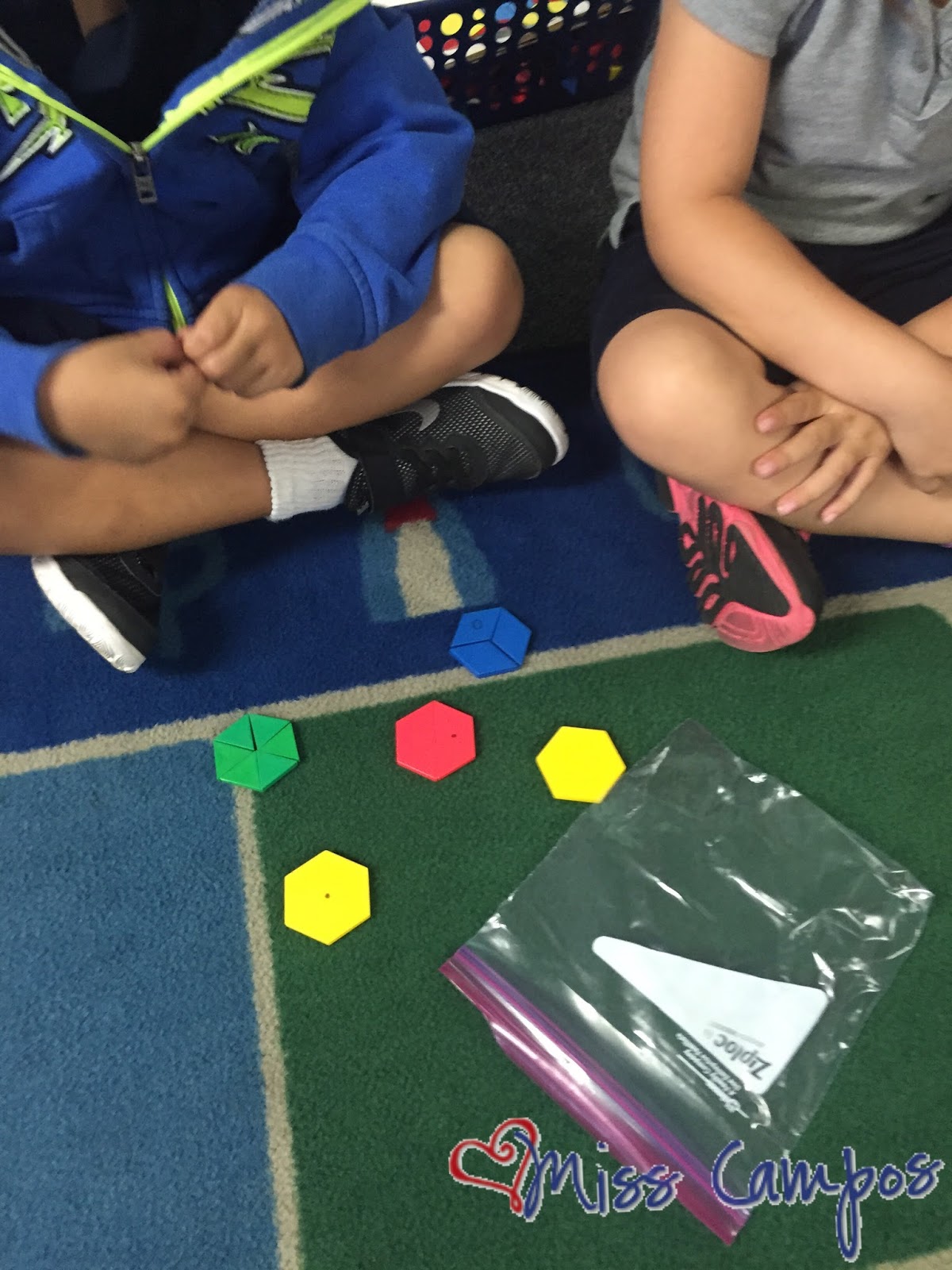
Building Hexagons

They worked with a partner since I only had enough shapes to prep 12 bags for 24 students to share. I would have had enough for 24 bags but those pesky little, green triangles ran out. Ah Well! It turned out great anyway. I'd say the hardest part was angling the triangles correctly enough to form half a hexagon. Once they cleared that hurdle it was easy. 

Building Hexagons

This recording sheet we used is below. I got it from the crisscrossapplesauce blog and it came in real handy. It was a freebie on her blog. Here is her link: (Hexagon FREEBIE) My kids loved it so much. I think I will run it off again and use it with the baggies as a math center for the rest of the week.

Making Hexagons with Pattern Blocks

At the end of this day's math session,  I announced that I was KIDNAPPING THE HEXAGONS from their beloved shapes puzzle basket. All that was left were the other 2D shapes: rhombus, square, trapezoid, and triangles.
Building Hexagons with other 2D shapes
This meant that kids had to memorize how to build hexagons using the three other ways we found to fill in their favorite puzzles. 

Replacing Hexagons with triangles, trapezoids, and rhombi

I heard a few gasps and then a little girl said, "but their not yellow!" I said, "That's okay. You can still replace the missing hexagons even if the shapes are different colors than what's on the mat."

The next day they did fine and I felt really proud of them. We wrapped up the next day by bring out the super fun pattern block stickers! We built hexagons in as many different ways as we could.

Here is another way we practice the characteristics of shapes. We used popsicle sticks on the rug.


I modeled how to make a few shapes on the rug and challenged the kids to name my shape. Then I projected shape clip art on my class' Promethean Board and passed out bundles of popsicle sticks in different colors. Each bundle had six sticks since we have been studying 2D shapes with no more than six sides. Once we all had out bundles we created the shapes I projected on the board one after the other. It was loads of fun!


Some kids had a hard time with the rhombus and hexagon. Rightfully so since those shapes are pretty tricky. The kids were very helpful when their neighbor was struggling to make a shape. We talked about the number of sides and vertices as well. We made different size triangles using either just three popsicle sticks or up to 6 to make each side longer. 

The only hard part was cleaning up the popsicle sticks. Most kids did not have the fine motor skills to tie the bunches back up. I recruited the help of girls with long hair to help me and the rest of the class tie up the bunhes. They usually know how to tie up their pony tails so tying up a small bunch of popsicle sticks was a piece of cake!